
When You’re Caught Off Guard: A Structure for Responding in Real Time
Not every speaking opportunity comes with advance notice. A client calls with a question, a colleague stops by, or a senior leader asks for your perspective in passing. In these moments, you don’t have time to outline your thinking — but you still need to respond with clarity.
Structure makes that possible.
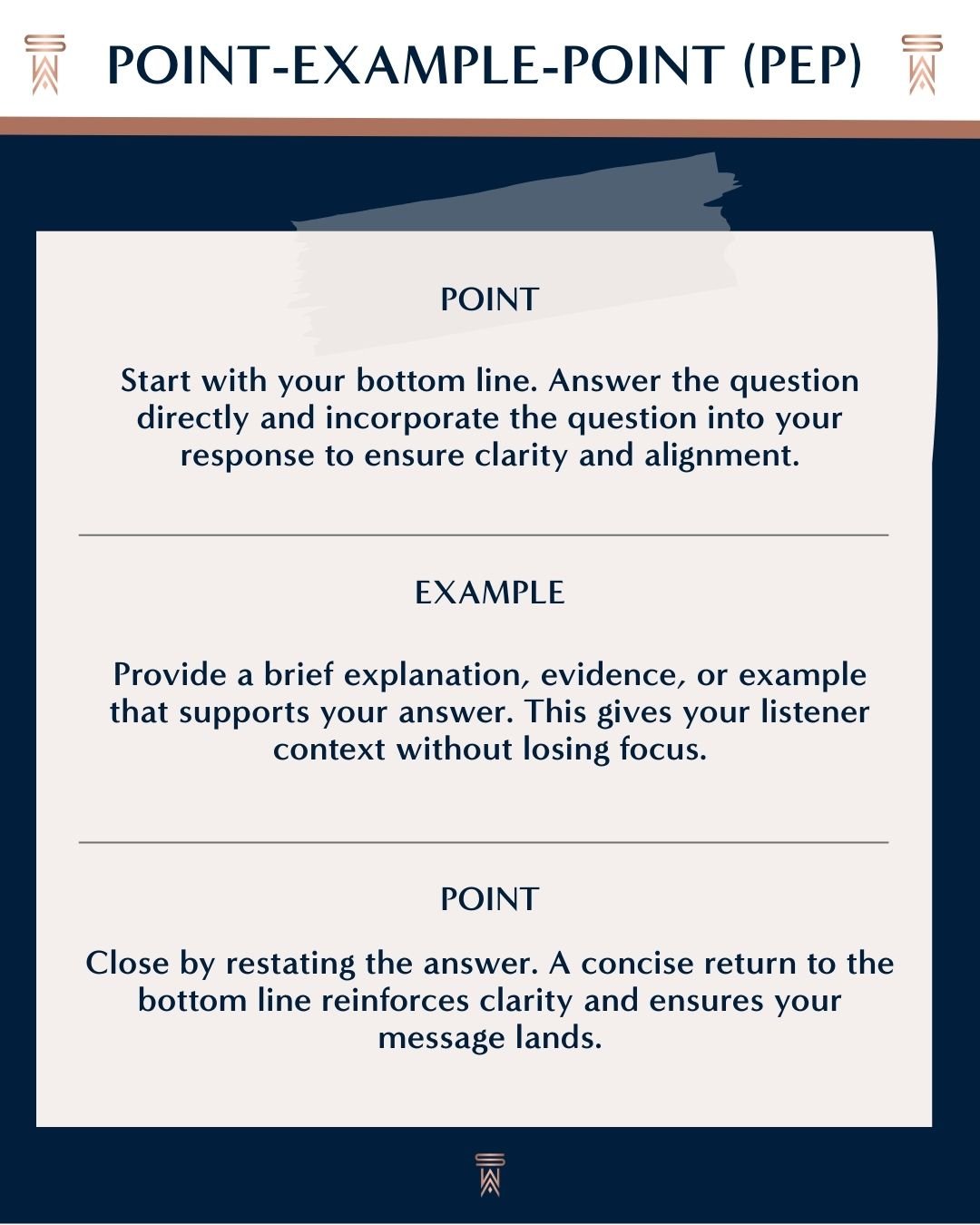
One simple framework we teach at Spoken with Authority, developed by our colleague Robert Gordon, Esq., is PEP: Point–Example–Point structure, inspired by Dorothy Leeds of “Power Speak”, Berkley Books 1988. It is designed for impromptu situations — drop-in conversations, unexpected questions, unplanned discussions, or anytime you need to give an explanation to an audience.
Why It Works
PEP works because it is organized and easy for your audience to absorb and remember. The structure goes full circle, creating a sense of completeness while often creating the illusion of brevity — even when the response includes detail. Together, these elements enhance the speaker’s credibility. PEP helps audiences make sense of what you are saying, prevents communicators from burying the answer in background or appearing evasive, reduces hedging, and creates a clear throughline listeners can follow. Your audience receives the bottom line up front, which provides immediate clarity. The explanation adds substance to the initial answer, and the closing point reinforces that you have directly addressed the question.
Many high-impact professional interactions happen outside formal presentations. Having a reliable structure allows you to contribute with confidence in those moments.
When you’re asked for input unexpectedly, pause briefly and identify:
• Your main point — state it immediately.
• Provide support for that point.
• Sum up with an even shorter version of your opening point.
Preparation is not always an advance rehearsal. Often, it is having a structure you can trust when the moment arrives.
At Spoken with Authority, we help leaders communicate with clarity in both planned and unplanned moments. If responding in real time is a critical part of your role or for those at your organization, we invite you to schedule a consultation to assess your current communication patterns and identify targeted strategies that strengthen credibility and decision-making presence.
